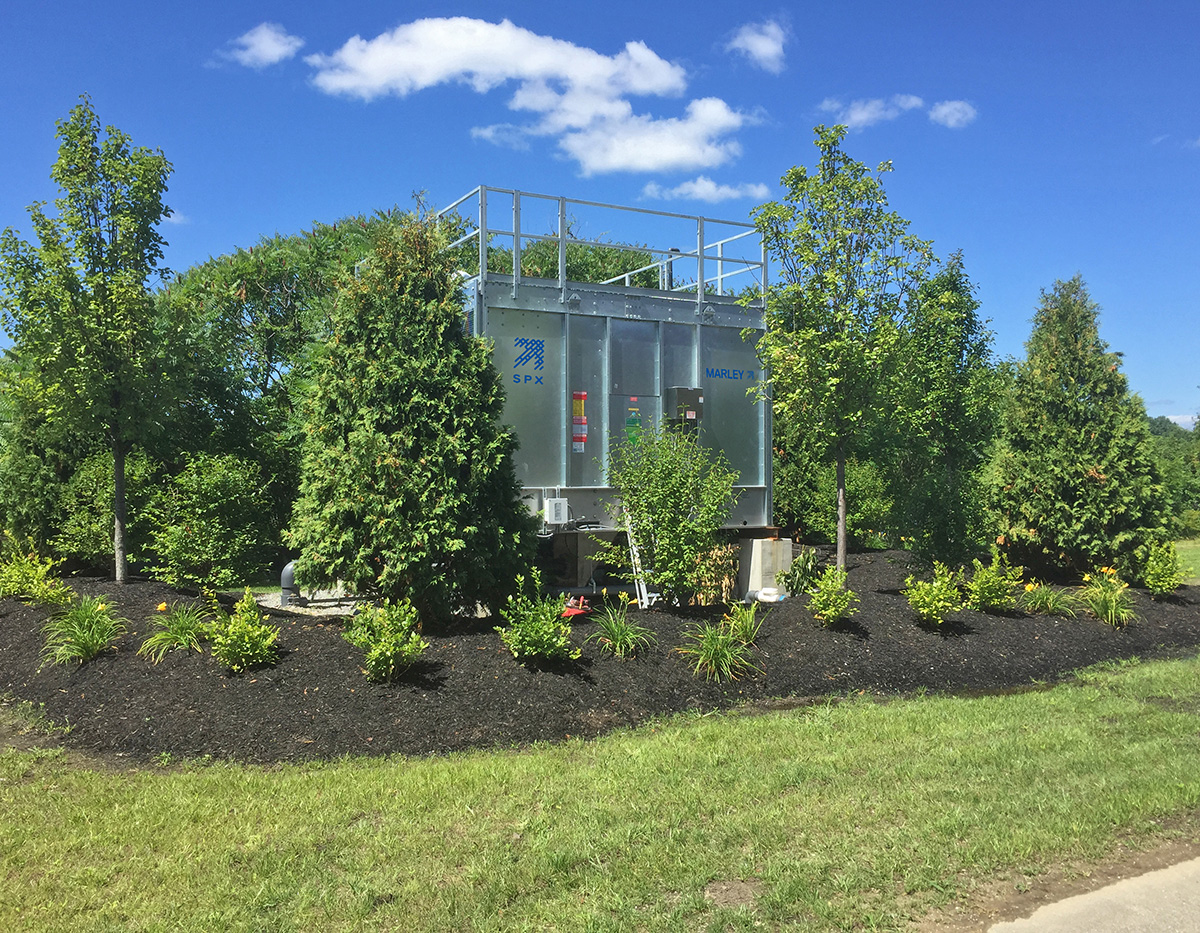
As cooling systems are increasingly deployed near occupied spaces, acoustic performance has become a more important consideration in HVAC and industrial cooling design. Hospitals, university campuses, data centers, commercial buildings, mixed-use developments and other urban projects often require cooling equipment to operate within strict sound limitations while still maintaining thermal performance and energy efficiency.
Successfully designing for sound-sensitive environments typically requires a multi-faceted approach. Instead, engineers often combine multiple sound reduction strategies to achieve the right balance between acoustics, performance, footprint and cost. Understanding sound targets early in the design process can help project teams select the most effective approach while avoiding costly mitigation measures later in the project lifecycle.
Below are several key strategies commonly used to reduce cooling tower sound levels in sound-sensitive applications.
- Optimize Equipment Orientation and Placement
One of the most effective and economical sound reduction strategies is thoughtful equipment placement. Depending on cooling tower design and airflow patterns, certain sides of cooling equipment may operate more quietly than others. For example, the casing side of a crossflow cooling tower often generates lower sound levels than the air inlet side.
Distance also significantly impacts acoustic performance. When site conditions permit, increasing the separation between cooling equipment and sound-sensitive areas can reduce sound levels without additional equipment costs. Sound pressure typically decreases by approximately 6 dBA each time the distance to the receiver is doubled.
Addressing equipment orientation and placement early in the design process can often reduce the need for more extensive mitigation measures later.
- Reduce Fan Speed and Fan Power
Fans are among the primary sound sources in cooling equipment, making fan speed an important factor in overall acoustic performance. Lower fan speeds generally result in lower sound levels.
Selecting larger equipment with greater heat transfer capacity can allow systems to meet thermal requirements while operating at reduced fan speeds. Variable frequency drives (VFDs) can further reduce sound during periods when full cooling capacity is not needed. Systems with redundant cells may also allow quieter operation by distributing load across multiple cells.
Even modest reductions in fan speed can provide noticeable sound benefits. A 25% reduction in fan speed can reduce fan sound by approximately 6 dBA while also lowering energy consumption.
- Select the Appropriate Fan Configuration
Fan design plays a major role in cooling tower acoustics. Factors such as blade shape, blade count and rotational speed all influence noise generation.
Standard low-sound fans provide an effective balance between airflow and acoustics. Quiet fan options often use additional blades and lower operating speeds to achieve further sound reduction with modest cost increases.
For projects with more demanding sound requirements, ultra-quiet fan designs may offer substantial reductions through advanced airfoil blade designs and lower operating speeds.
The optimal fan configuration depends on project sound goals, thermal performance requirements, available space, and budget.
- Utilize Barriers and Enclosures
Physical barriers are an effective way to reduce sound transmission when properly designed and positioned. Walls or enclosures placed between cooling equipment and nearby occupied areas can help block and redirect sound.
In some applications, cooling towers are incorporated into architectural enclosures that provide both aesthetic screening and acoustic benefits. The effectiveness of these solutions depends on factors such as placement, height, construction materials and surrounding site conditions.
Barriers and enclosures are generally most effective when considered early in the overall site design process.
- Consider Advanced Attenuation Solutions
Projects with very strict sound requirements may require dedicated attenuation systems. Sound attenuation baffles can be installed in entering or leaving air streams to absorb sound energy and reduce overall noise levels.
Because attenuation systems add cost, require space and may affect thermal performance, they are often used after other mitigation options have been evaluated. Some cooling towers may also incorporate splash attenuation systems that reduce water noise by slowing falling water before it reaches the collection basin.
When carefully applied, attenuation solutions can provide significant acoustic benefits for highly sound-sensitive applications.
Balancing Acoustic Performance, Efficiency and Cost
Designing cooling solutions for sound-sensitive environments is rarely about a single technology or component. Successful projects often combine multiple strategies including equipment placement, fan selection, operational control, and barriers and attenuation to achieve the desired acoustic outcome.
By understanding project sound targets early and incorporating the right mitigation strategies during system design, engineers can more effectively balance sound performance, thermal efficiency, operational flexibility and overall project cost.
As noise ordinances become stricter across healthcare, data center, campus and urban commercial applications, thoughtful sound design will remain an increasingly important part of effective cooling system design.
For additional confidence in cooling tower acoustic performance, the Cooling Technology Institute (CTI) Sound Certification program provides independent verification of manufacturers’ published sound data. CTI third-party validation helps engineers and facility owners more confidently evaluate and compare cooling tower solutions when designing for sound-sensitive applications. SPX Cooling Tech was the first cooling tower manufacturer to achieve CTI Sound Certification, demonstrating a longstanding commitment to verified acoustic performance and giving customers greater confidence in selecting solutions for sound-sensitive applications.
Ready to evaluate options for your application? Use CoolSpec® Product Selector to configure Marley cooling tower solutions based on your project requirements.